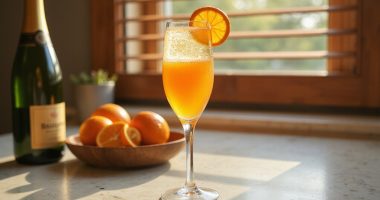
The bottomless mimosa started as a desperate restaurant trick to fill empty Sunday tables in the 1970s. What began with a lone Parisian bartender mixing champagne and OJ in 1925 morphed into America’s favorite excuse for day drinking. Restaurants discovered the magic formula: slap a $19.99 price tag on unlimited bubbly, require food purchases, enforce two-hour limits, and watch hungover millennials flood in. The full story involves Hitchcock, hunting parties, and legal battles.

Who decided that Sunday mornings needed unlimited champagne? The answer takes us back to London’s Mayfair set in 1961, when Earl Mountbatten brought this fizzy French concoction to the Queen after a Riviera holiday. The royals went wild for it. A new fad was born.
The mimosa itself had been kicking around since 1925, when a Ritz Paris bartender decided orange juice needed champagne. Or maybe it was someone on the French Riviera in the 1920s. Nobody’s quite sure. What we do know is that it was basically a rip-off of the Buck’s Fizz, invented at Buck’s Club in London in 1921. Same ingredients. Different proportions. Groundbreaking.
Orange juice needed champagne, and nobody could agree who decided this first.
By the 1970s, Americans had discovered this European import and slapped it on every brunch menu from Chicago to Dallas. Alfred Hitchcock had already been drinking them for years, helping turn the cocktail into a celebrity favorite. Sunday brunch itself came from 19th-century English hunting parties, because apparently shooting things works up an appetite for eggs Benedict and day drinking. The mimosa nestled right in beside the bloody mary as the official cocktail of people who can’t face Sunday mornings sober.
Then someone had a brilliant idea. Why limit customers to just one? Enter the bottomless mimosa, that beautiful marriage of psychological pricing and hedonistic abandon. Restaurants realized they could pack their slow Sunday shifts by promising unlimited bubbles.
Slap a two-hour limit on it, require a food purchase, and suddenly you’re legal and profitable. The concept spread like gossip at a garden party. It transformed brunch from a meal into an event. A cultural phenomenon. Weekend warriors lined up for their chance at infinite champagne, convinced they were getting luxury on the cheap.
Restaurants used it as a loss leader, banking on food sales and turnover to keep the lights on. The psychology was perfect: price it at $19.99 instead of $20, and watch customers’ brains light up at the “deal.” Of course, the fun police showed up eventually. Some states banned unlimited alcohol promotions entirely. Others wrapped them in so much red tape that restaurants gave up.
Time restrictions, food requirements, strict ID checks. The lawyers had their say. But bottomless mimosas survived. They’re still here, turning Sunday mornings into champagne-soaked social occasions. Ernest Hemingway would be proud. Or horrified. Probably both.
Frequently Asked Questions
Are Bottomless Mimosas Legal in All States?
No, they’re not. Michigan and Ohio explicitly ban bottomless drinks.
Michigan won’t let establishments pour endless mimosas. Ohio’s even stricter—no unlimited booze for a fixed price, period.
Though clever Ohio spots sell champagne bottles with unlimited OJ instead. Other states have similar laws against all-you-can-drink deals.
Some dry counties ban alcohol entirely. So that bottomless brunch? Depends entirely on where you’re sitting.
What’s the Typical Time Limit for Bottomless Mimosa Service?
Two hours. That’s the magic number most places slap on their bottomless mimosa deals.
Some joints get stingy with 90-minute limits. Others? They’ll cut you off after one measly hour, especially those San Francisco spots counting every penny.
Happy Camper gives you the full two hours. Han Palace too, but only if you’re eating.
The Pink Elephant? One hour, then you’re done.
Time flies when you’re drowning in cheap champagne.
Can I Get a Non-Alcoholic Version of Bottomless Mimosas?
Most brunch spots will pour virgin mimosas till the cows come home.
Same deal, no booze. They’ll charge less—usually half price—but still call it “bottomless” like that’s transformative.
Orange juice meets sparkling water. Groundbreaking.
Some places get fancy with kombucha or mocktail champagne, but let’s be real: it’s glorified juice.
Perfect for the pregnant, the designated drivers, and whoever’s pretending January’s dry.
How Much Do Restaurants Typically Charge for Bottomless Mimosas?
Restaurants charge anywhere from ten bucks to thirty-two dollars for bottomless mimosas.
Ten dollars. For unlimited drinks. Sure, it’s mostly orange juice and the world’s saddest sparkling wine, but still.
Most places hover around twenty-one to twenty-five bucks. The fancy spots? Thirty-two dollars. Same cheap bubbles, just served on nicer plates.
Some joints bundle it with brunch for thirty-two total. Time limit’s usually two hours. Because nothing says “bottomless” like a deadline.
Do I Need a Reservation for Bottomless Mimosa Brunch?
Most bottomless brunch spots want reservations. Yardbird straight-up requires them.
The Lobby “suggests” it, which is restaurant speak for “good luck getting a table without one.”
Some joints start your two-hour clock when the reservation begins, not when drinks arrive. Harsh.
Shaw’s Tavern and others enforce the whole-table rule — everyone’s drinking or nobody is.
Walk-ins? Sure, if you enjoy standing around watching other people’s mimosas.